
learning tarot can be frustrating, but molting is not supposed to be easy.
In my experience, the biggest challenge tarot beginners have is jumping to learn the “meaning” of a card before they practice contemplating the image.
The beauty of a tool with such a vast and deep legacy is that we can spend years devouring the history, symbolism, and others’ interpretations of each card. But if we get lost in the intellectual endeavor of Tarot and ignore all of the other ways we come to know the cards, we will never be full.
When we reach too quickly for meaning outside of ourselves, we miss the process of building a relationship with the cards, and getting to know ourselves in response to the cards. Our intuitive self doesn’t live in the words of others, although it may or may not find resonance there. It lives in our body, our sensations, our emotions, and all that is arising in the moment.
Tarot isn’t transactional and it isn’t linear, either. As we find other ways to relate to it, we begin to get more comfortable with complexity and multivalence. The meaning isn’t this or that, it’s this and this and that, too. It’s a feeling or a gesture or a brief interaction that occurs a week after we pulled that card, but draws us right back to it. Through the conscious. contemplative practice of being with the cards, we are able to build self-trust, knowing, and a relationship to the mystery.
In my experience, tarot supports our creativity and our authentic flourishing. It helps us remember who we are.
It is a wonderful helper in illuminating harmful habits and perspectives that we’ve internalized from systems of modernity. As we continue to work with it, we may find that ways of relating and being that are not in alignment with our fuller self begin to shed and fall away.
Tarot teaches us to learn to sit with the image, and ourselves, and to practice other ways of knowing, including not knowing at all.

The tarot can guide us to be the creative beings we are here to be, and to be more open, loving, and authentic in a world that needs our fullness.
The process of learning tarot is deeply introspective, it involves witnessing, excavating, and composting as much as it involves memorizing and studying.
In my experience, beginners might approach the cards with fear, and project critical or moralistic viewpoints upon them. Or they come to them striving to test their validity and accuracy, looking to prove something, instead of to receive something.
The mysterious images and archetypes of the tarot have been inviting people to experience their wisdom for centuries. They are a living, participatory, spiritual text, they have nothing to prove. They also hold no judgment – in my opinion, they are unconditionally supportive of us, even loving, and hilarious, too! Even if we never heed their guidance, even if we put them down and don’t come back for months or years. The choice is always ours, after all, and the cards will just show us what’s helpful to know about it.
Below I’ve developed four invitations for you to apply to your own “work” with the cards. These are the anchors of my own practice, ways to go beyond memorizing card meanings, and into building a deeper relationship with them.
I do aim to build out the other resources on this page to have more meditations and musings on each card, as a starting point for your own explorations, and I also have suggested books and other resources that I found most helpful in my own learning process linked below.
Working with the tarot can be fun, can be humbling, and can be deeply, profoundly transformative. Go slow, there is nowhere to get to, you and the cards are already here.
If you want support with building your connection to the cards, my lessons weave readings with an extended exploration of the cards, tailored to your needs and your practice with them.
Invitations for you to deepen your relationship with the Tarot
-
How we relate to our own tarot practice is a beautiful place to begin noticing the messages of the cards. Are we showing up to the tarot with guilt or shame around not having more regular habits? Are we giving the cards blanket power to predict our future and tell us what we “should” do? Is there a more supportive way to ask this, or work with them, for us right now?
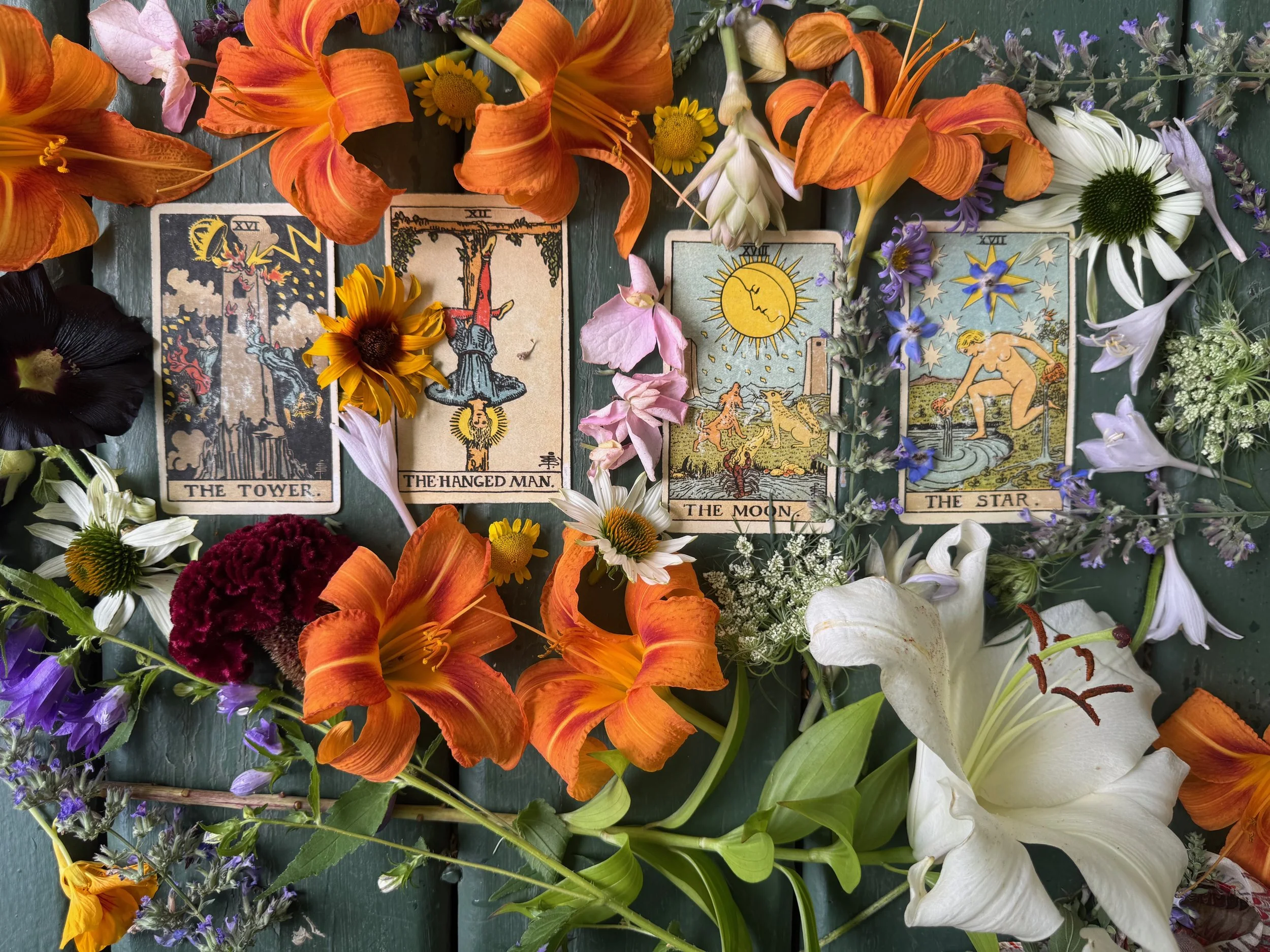
The Tower card teaches us that even structures designed to support us may become too rigid to hold. As you learn to read the cards for yourself, I invite you to be willing to deconstruct any structure that becomes too rigid, from practice intentions to card meanings. I find it to be true that the cards continue to surprise and delight me, teaching me new meanings and ways of working with them all the time, when I am open and listening.
-
The Tarot holds no value judgments about us, but we do hold value judgments about the cards.
Our notions of good and bad cards can limit us to using the Tarot for validation and affirmation, and leave us lost or disappointed when these needs are unmet. There is no shame in seeking validation. It simply restricts our ability to relate more deeply to the cards when we are unconscious of it.
The Hanged Man shows us that we can find support and an unbound perspective even when restricted.
If the cards are a tool to support us, then every card is supportive. Maybe that means you’re ready to grieve, confront a hard truth, or turn inwards and tend to an isolated part of self. To engage in a Tarot practice is not to bypass our hardships and difficulties. It is to be witnessed in our entirety, and have that reflected back to us.
Ask yourself, how is this here to support me right now?
If you feel trepidation or dread about what the cards might be leading you towards, you can ask them for support. You can describe your fears and ask how you might best tend to them. You can ask the cards for a guide on this journey, you can ask them to help you reframe a difficult narrative, to show you what you’re missing, or to show you an alternate path through a challenge. When the cards are always supportive, the options available to us are more than we know.
-
We often approach the tarot from a place of linearity, wanting certainty on what it all means, what is going to happen, and what we should do. This is something to recognize and tend to in ourself. Like the wolf in the moon card, our world is wild and uncontrollable. When we use tarot in an effort to control, we miss out on its beautiful ability to guide us more deeply into the mystery. The tarot is a nonlinear tool, and we can be endlessly creative with it when we embrace the unknown, in cards and in life.
Card meanings are also mysterious and always a little unknown, too. I invite you to shed the linear notion that you can arrive at learning all of the card meanings, and instead engage with them as living fields which we can never know in their entirety, just as we can never fully know a forest or a desert. Any encounter in these landscapes contains mystery and surprise, and requires our dedicated presence and awareness. So too with tarot.
The Moon card can represent a period of confusion or an underworld journey, the unknown and uncertain, nonlinearity, the duality of tame and wild, and the mysteries of our subconscious. Sometimes the Moon card is a literal invitation to connect with the moon in the sky. While possibilities are endless, the field itself is defined. The Moon is not the Sun, the forest is not the desert.
Trust your own wisdom and ability to explore the field as much as you trust traditional meanings. If you have trepidation or aversion about what a card might mean for you in this moment, that is something to sit with and explore. Sometimes we dread a card because we have given too much power away to the deck. Other times, we are avoiding something the cards may want us to see. Get creative with these aversions and how you relate to them. Speak it out loud, make art with them, make an altar for the card, see how your relationship to it changes over time and tending.
If the meaning of a card is unknown to you in the moment, invite it to find you when you are ready instead of needing to figure it out right away. If more than one meaning is coming up, notice them all, and invite more to visit.
-
The Star reminds us of our place in the cosmos, and the healing available to us in present time. As a nonlinear tool, the tarot attunes us to cycles and dimensions of self. Working with it on a regular basis offers us ways to reframe and heal our past, as well as receive guidance for the future. This is a spiralic practice, acknowledging the past is never truly done, and the future is not fixed.
It is my belief that the cards support our spiritual growth above all else. In this way, there’s not one action we “should” do more than another. There are patterns we repeat, times we become conscious of these cycles, and times we break them.
As you work with the cards, you will find some show up repeatedly for you. These might indicate the nature of the cycle you are in, or a pattern the cards want you to notice. You can attune to this by exploring the card’s symbolism more deeply through myth, active imagination, art making, or by designing your own ritual to honor this phase.
The beauty of spending the time and dedication to create your own relationship to the tarot, is that it can become a support guide for your soul’s journey. Instead of asking what you “should” do, you will trust that your deck knows who you are becoming, and the values you want to enact through your life. This is a relationship that exists outside of time and mundane concerns, although the cards can help with those, too.
Recommended Resources for Tarot Study
-
There are so many amazing Tarot books if you want to build a bursting library, but where to begin? These are my essential three:
78 Degrees of Wisdom by Rachel Pollack [the best beginner’s guide to the cards imo]
Tarot for Yourself: A Workbook for the Inward Journey by Mary K. Greer [Greer’s tarot scholarship is essential, and this workbook is a perfect entry into her work]
Red Tarot: A Decolonial Guide to Divinatory Literacy by Christopher Marmolejo [beautiful and essential book for the intermediate -advanced practitioner]
Bonus: Many older Tarot texts are available online, such as the Introduction to Tarot by Paul Foster Case from 1922.
-
Between the Worlds by Amanda Yates Garcia [beautiful deep dives into each card]
Root Lock Radio by Weston [no longer active, but great primer and introduction to Tarot]
Slow Tarot by me [Read along with me each month!]